
Ben Nowlan CEO
Eleven years ago, “fast delivery” meant two or three days. That was fine… until it wasn’t.
Today, customers don’t just want speed. They want speed they can trust. They want reliable ETAs. Fewer exceptions. Fewer “sorry, it’s delayed” emails. And when that reliability shows up, something interesting happens: expectations rise, baskets grow, and loyalty shifts to whoever delivers the best experience.
That’s the reality Australian retailers are navigating right now, and it’s what we’ll be unpacking at the Retail Fulfilment Summit: how to adapt global fulfilment models for Australia, and how to build same day capability that holds up commercially, operationally, and in the eyes of your customers.
Because same day only becomes a long-term advantage when it’s built like an operating system, not a workaround.
The global lesson: same day works when it’s engineered, not improvised
When you look at mature same day markets globally, the winners don’t treat last-mile as a bolt-on. They treat it as infrastructure. A system that aligns four things:
 |
Proximity The right inventory close to demand |
 |
Inventory truth Real time visibility you can trust |
 |
Unit economics Cost-to-serve that works when you ship from store |

|
Governance Controls that protect reliability at scale |
Without those, “same day” becomes heroics. And heroics don’t scale.
The true cost of same day: shipping from store is powerful, and unforgiving
Shipping from store is often the fastest path to same day coverage. It’s also where the economics can quietly fall apart.
The reality is that stores weren’t designed to behave like DCs. Labour is variable. Pick-pack consistency varies by location. Inventory accuracy is rarely perfect. And the moment you run same day without orchestration and controls, you pay for it in:
- exceptions and re-deliveries
- customer contacts and refunds
- operational noise
- margin leakage
Same day is absolutely achievable from store, but only when you treat it as a designed operating model, not a delivery option.
Proximity as strategy: the store network becomes fulfilment density
The shift we’re seeing is retailers rethinking the store network not just as a sales footprint, but as fulfilment density.
The question isn’t “how many stores do we have?” It’s “how quickly can we place reliable inventory within reach of customers?”
This is where global models translate well into Australia: use stores, micro-fulfilment, and DCs as a coordinated network. Let demand shape where you stage inventory. Let data shape the promise you make. And treat same day as an outcome of the network, not a feature.
What changes when delivery gets faster and more reliable
Speed gets the headline. Reliability changes behaviour. When customers believe your promise:

|
Conversion improves Confidence removes hesitation |

|
Basket size increases People consolidate purchases |

|
Repeat rate grows Trust becomes habit |

|
Brand perception lifts Delivery becomes part of the product |
That’s why this isn’t only a logistics conversation. It’s a customer experience conversation. Delivery is now a front-of-house brand moment.
Infrastructure as a moat: scalable same day capability becomes defensible advantage
The retailers building a competitive moat in the next phase won’t be the ones with the loudest delivery claims.
They’ll be the ones with the best system behind the claim. Same day at scale requires:
- a national network that performs consistently
- technology that orchestrates fulfilment decisions
- governance that keeps reliability high, even during peaks
- transparency and controls that let retailers operate confidently
This is where infrastructure becomes defensible. It becomes hard to copy. And it becomes an advantage you can build on.
So where does Sherpa fit?
Sherpa is the logistics OS for independent retailers - helping them run same day at scale through a national network, technology, and governance. We’re the #1 independent same day carrier: a carrier that carries your brand and customer experience (not a marketplace that takes it). In one line: The OS behind independent same day.
What that means in practice:
- Carrier of your brand: neutral, brand-first delivery (no marketplace agenda)
- Carrier of your customer experience: reliable promises, fewer exceptions, better outcomes
- Carrier of your retail operations: network + technology + governance working as one system
Same day shouldn’t force trade-offs. It should align cost, CX and speed. That’s the system we’re building.
A simple way to think about it
If you’re exploring same day, don’t start with “which carrier?”
Start with:
- Where will proximity come from? (stores, DCs, micro-DCs)
- What’s your inventory truth? (real-time stock accuracy)
- Do the unit economics hold up? (especially ship-from-store)
- What governance protects reliability? (controls, rules, escalation)
Then choose the partner that can run that system with you.
If you’re at the Retail Fulfilment Summit, come say hi after the panel.
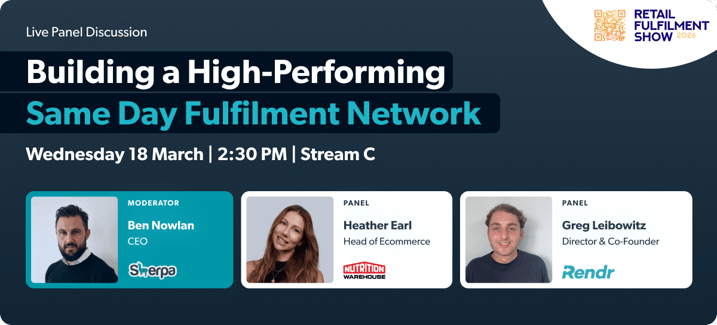
If you’re not, connect with our team and we’ll share the short framework we use to think about same day at scale.
Ben
Sherpa
.png?height=200&name=FB_01%20(2).png)